Upper-Limb Prosthetics
Upper-limb prosthetics live or die on whether they help with the things you actually want to do. A device that’s impressive on paper but uncomfortable to wear, slow to use, or limited to one task ends up in the closet. We work the other direction: we ask what activities matter, then fit the device that gets you there.
Body-powered systems remain the workhorse for many patients, durable, lightweight, mechanically reliable, and direct in their feedback. Myoelectric and multi-articulating systems open up grasp patterns and finer control. Passive prostheses (including silicone-restored hands) prioritize appearance and protection.
We work with the full range of premium componentry. Component choice follows the patient, not the showroom.
Book a consultation →The full anatomical range.
From a single finger to a full shoulder disarticulation, each level brings its own clinical considerations, componentry options, and control strategy.
Shoulder disarticulation
The most complex upper-limb fitting. Endoskeletal and exoskeletal designs with coordinated elbow, wrist, and terminal-device control.
Transhumeral (above-elbow)
Elbow units, terminal devices, harness or self-suspending sockets, full myoelectric integration when appropriate.
Transradial (below-elbow)
The most common upper-limb fitting. Body-powered, myoelectric, or hybrid systems for unilateral and bilateral patients.
Hand or partial-hand
Custom partial-hand prostheses including i-Digits, X-Finger, and silicone-restoration options. See also our finger prosthetics page.
Bilateral upper-limb
Patients with two upper-limb fittings need a coordinated systems approach, matched harnessing, complementary control, paired training.
Pediatric upper-limb
Growing devices for growing children, see our pediatric page for the full pediatric approach.
The technology behind the fitting.
- Multi-articulating handsMulti-articulating hands and emerging systems, with full programming and training.
- Body-powered systemsHarness-driven cable systems for durable, mechanical control, often the right answer for heavy daily use.
- Myoelectric & pattern recognitionSurface EMG sensors with pattern-recognition systems for intuitive multi-grip control.
- Activity-specific terminalsHooks, sport TDs, kitchen and tool-grip devices for specific work or hobby use.
- Silicone restorationHand-painted cosmetic restoration for patients who prioritize appearance over active function.
- Lifetime fitting supportSocket refits, terminal device service, harness changes, and component updates as your needs evolve.
Patients we commonly fit.
- Recent upper-limb amputees ready to begin prosthetic fitting after wound healing.
- Patients who’ve tried a prosthesis but found it unwearable or unhelpful for their daily work.
- Bilateral upper-limb amputees who need a coordinated systems approach.
- Patients curious about transitioning from body-powered to myoelectric (or vice versa).
Our fitting process.
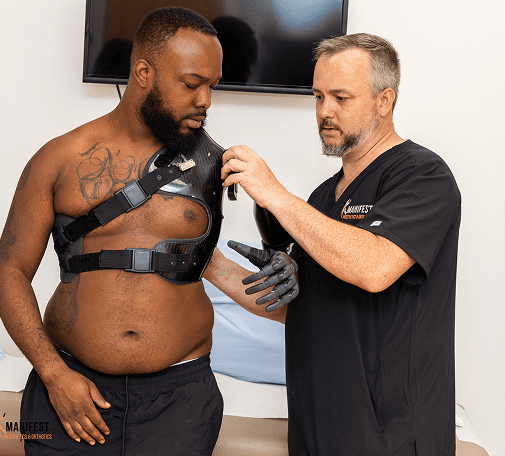
Activity interview
We map your daily routines, work demands, hobbies, what the device has to do to be worth wearing.
Scan & design
digital scan, socket design, and component selection, with realistic tradeoffs explained.
Fabrication & fitting
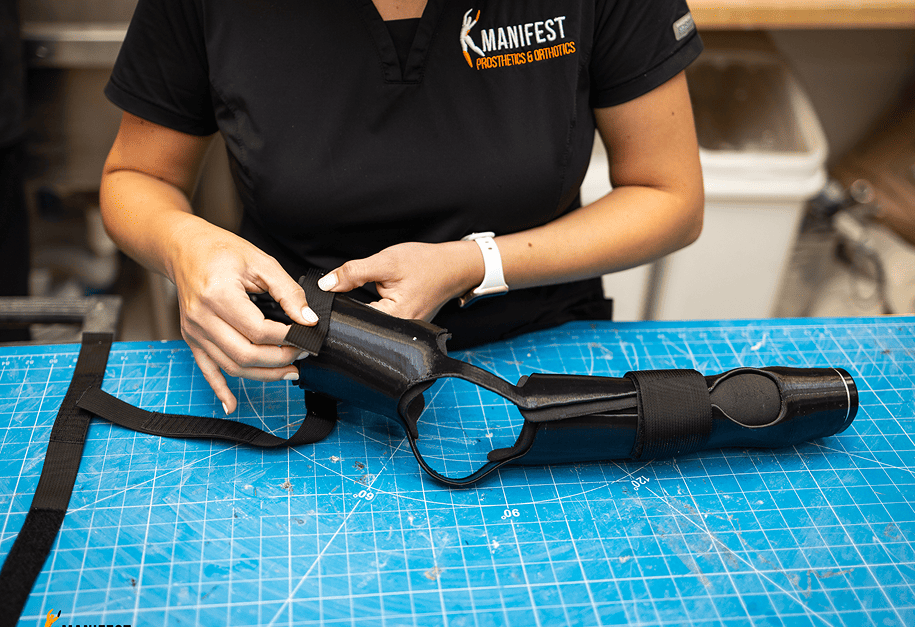
Built in our lab. Initial fit, harness adjustment, training begins.
Training & refinement
Myoelectric calibration, occupational therapy coordination, and adjustment over weeks of real-world use.
Why our fittings work.
Myoelectric fittings use surface EMG sensors that read the muscles in your residual limb. Pattern-recognition systems translate combinations of muscle signals into intuitive grasp patterns. We program, fit, and train on these systems in-house, then stay involved as you live with the device.
Common questions about upper-limb prosthetics.
Should I get a body-powered or myoelectric arm?
How long does a myoelectric fitting take?
Will I get sensation back?
Does insurance cover myoelectric arms?
Other ways we can help.
Let’s talk about what you need.
Free consultations. We answer the phone. We’ll tell you exactly what comes next.
Book a Free Consultation Call (813) 801-9110